

How Cilium Replaces iptables with eBPF — And Why It Makes Kubernetes Security Smarter
A deep dive into how Cilium leverages eBPF to move beyond iptables, enforce identity-based network policies, and bring intelligent security to Kubernetes

As a DevOps Engineer, I specialize in streamlining and automating software delivery processes utilizing advanced tools like Git, Terraform, Docker, and Kubernetes. I possess extensive experience managing cloud services from major providers like Amazon, Google, and Azure.
I excel at architecting secure CI/CD pipelines, integrating top-of-the-line security tools like Snyk and Checkmarx to ensure the delivery of secure and reliable software products.
In addition, I have a deep understanding of monitoring tools like Prometheus, Grafana, and ELK, which enable me to optimize performance and simplify cloud migration journeys. With my broad expertise and skills, I am well-equipped to help organizations achieve their software delivery and cloud management objectives.
Introduction
If you've been running Kubernetes in production for any length of time, you've probably stared at a NetworkPolicy YAML, applied it, and then asked yourself, "Is this actually working?"
The honest answer with traditional Kubernetes networking? It depends on how your CNI plugin implements it. And for most clusters, the answer involves iptables — a Linux firewall tool designed in the late 1990s, long before anyone imagined container orchestration at scale.
Kubernetes has evolved dramatically. Your networking layer should too.
Enter Cilium — a CNI (Container Network Interface) plugin that throws out the iptables rulebook entirely and replaces it with eBPF (Extended Berkeley Packet Filter), a revolutionary kernel technology that runs sandboxed programmes inside the Linux kernel itself.
In this blog, I'll walk you through:
Why iptables struggles in modern Kubernetes environments
What eBPF actually is and how it works
How Cilium uses eBPF to enforce network policies
The identity-based security model that makes Cilium fundamentally smarter
Why this matters for your DevSecOps posture
Who should read this? Platform engineers, DevSecOps engineers, and Kubernetes administrators who want to understand why their networking layer matters as much as their application code.
The iptables Problem in Kubernetes
Before we talk about solutions, let's understand what we're solving.
What iptables Was Built For
iptables is a Linux kernel firewall that works by matching packets against a list of rules and deciding what to do with them – accept, drop, forward, or NAT. It was designed for static, predictable network environments. A firewall on a server. Rules that don't change often. A handful of IP addresses.
That's not Kubernetes.
Why iptables Breaks Down at Scale
In a Kubernetes cluster, pods come and go constantly. Every new pod gets an IP address. Every service creates new iptables rules. Here's what that looks like at scale:
| Cluster Size | Approximate iptables Rules | Rule Evaluation per Packet |
|---|---|---|
| 10 pods | ~100 rules | Linear scan ~100 |
| 100 pods | ~1,000 rules | Linear scan ~1,000 |
| 1,000 pods | ~10,000 rules | Linear scan ~10,000 |
| 10,000 pods | ~100,000+ rules | Linear scan ~100,000+ |
iptables evaluates rules linearly. Every single packet traverses the entire ruleset until it finds a match. At 10,000+ pods, this becomes a serious latency and CPU bottleneck.
Beyond performance, there are deeper problems:
1. IP-based rules don't make sense in Kubernetes
Pods get ephemeral IPs. A pod that dies and restarts gets a new IP. If your network policy is tied to IP addresses, you're constantly chasing moving targets. iptables rules become stale the moment a pod restarts.
2. No visibility
iptables silently drops packets. You get no insight into why traffic was blocked, which pod was the source, or what policy matched. Debugging is painful.
3. Kernel space operations are slow to update
Adding or removing iptables rules requires locking the ruleset, modifying it, and flushing it. In a dynamic Kubernetes environment with hundreds of pods starting and stopping, this creates constant overhead.
4. kube-proxy limitations
Kubernetes is used kube-proxy to manage iptables rules for service load balancing. kube-proxy runs as a DaemonSet and updates iptables rules every time a service or endpoint changes. At scale, this becomes a bottleneck — and it's still fundamentally linear packet processing.
What Is eBPF?
eBPF stands for Extended Berkeley Packet Filter. The name is historical — the original BPF was used to filter network packets. eBPF is something far more powerful.
Think of eBPF as a safe, sandboxed virtual machine inside the Linux kernel that lets you run custom programs in response to kernel events — without modifying the kernel source code or loading kernel modules.
How eBPF Works
Here's the flow:
Your eBPF Program (C-like code)
        ↓
   LLVM Compiler
        ↓
   eBPF Bytecode
        ↓
  Kernel Verifier (safety check)
        ↓
  JIT Compilation (native machine code)
        ↓
  Kernel Hooks (kprobes, tracepoints, XDP, TC)
        ↓
  Runs in Kernel Space (zero context switching)
The kernel verifier is critical — before any eBPF program runs, the kernel verifies it won't crash the system, won't run infinite loops, and won't access memory it shouldn't. This is what makes eBPF safe to run in production.
Where eBPF Hooks Into the Kernel
eBPF programs can attach to dozens of kernel hook points:
XDP (eXpress Data Path) — Runs at the earliest point in the network stack, before the kernel even allocates a socket buffer. This is the fastest possible packet processing point.
TC (Traffic Control) — Runs at the traffic control layer, allowing both ingress and egress packet processing
kprobes/kretprobes — Attach to any kernel function call or return
tracepoints — Stable kernel instrumentation points
LSM hooks (Linux Security Module) — Hook into kernel security decisions
For networking, Cilium primarily uses XDP and TC hooks – meaning packets are processed at the kernel level before they ever reach userspace.
eBPF Maps — The Data Layer
eBPF programs don't work in isolation. They communicate with userspace and with each other through eBPF maps — key-value data structures that live in kernel memory.
Userspace (Cilium Agent)
        ↕ (reads/writes)
    eBPF Maps
    (kernel memory)
        ↕ (reads/writes)
  eBPF Programs
  (kernel hooks)
This is how Cilium updates network policies without restarting anything — it simply updates the eBPF maps, and the kernel-level programs immediately use the new data. No iptables flush. No lock. Near-instant propagation.
How Cilium Uses eBPF
Cilium is built from the ground up on eBPF. It doesn't wrap iptables or add an abstraction on top of it — it replaces the entire networking and policy enforcement path.
The Architecture
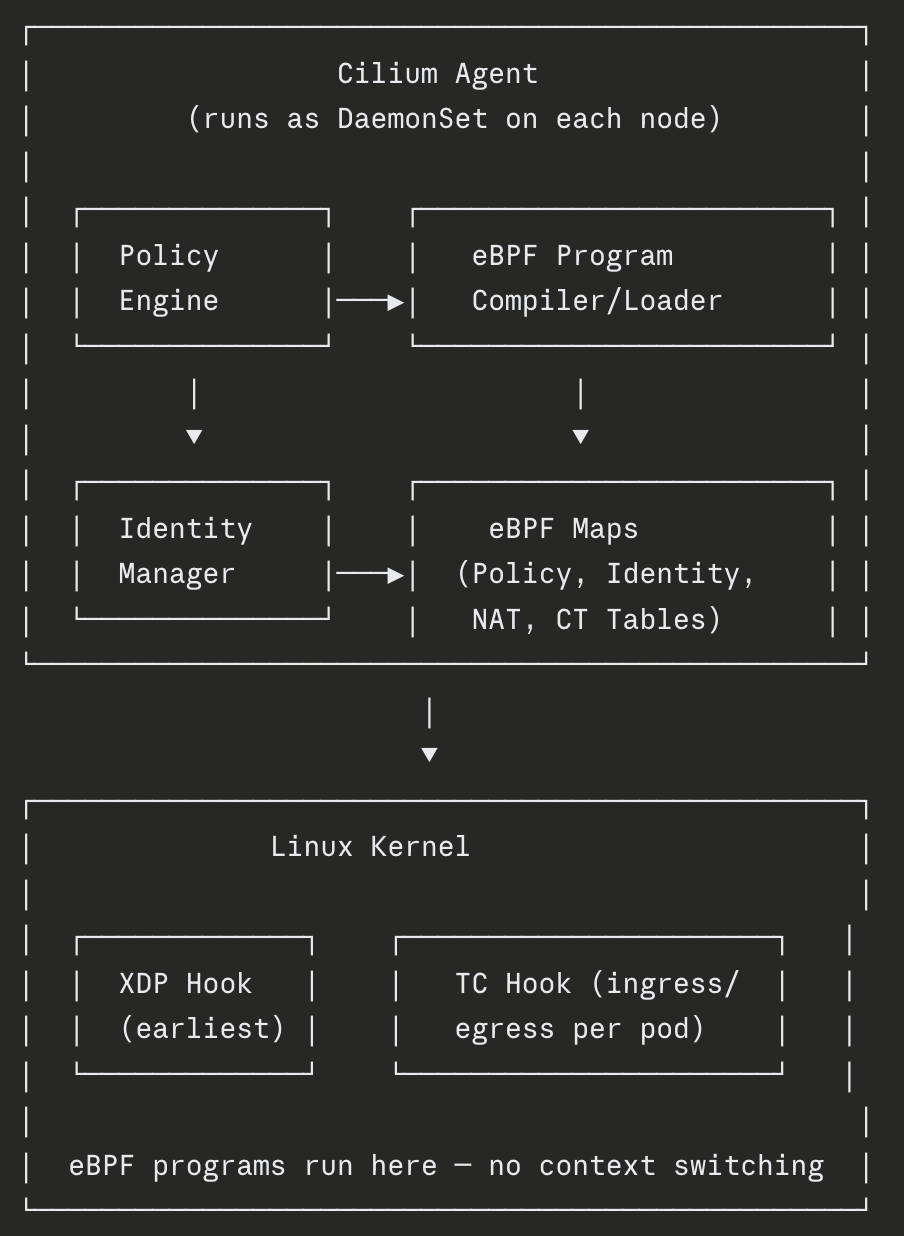
Replacing kube-proxy
One of the first things Cilium does is replace kube-proxy entirely.
Instead of iptables rules for service load balancing, Cilium uses eBPF maps to store service endpoints and uses kernel-level eBPF programs to perform load balancing directly. The result:
O(1) lookup time for service endpoints (hash map vs linear scan)
No iptables rules to manage or flush
Consistent latency regardless of cluster size
# Verify kube-proxy replacement in Cilium
kubectl exec -n kube-system ds/cilium -- cilium status | grep KubeProxyReplacement

# Expected output
KubeProxyReplacement: Strict
The Identity-Based Security Model
This is where Cilium fundamentally changes the game. And this is the part that makes Kubernetes security genuinely smarter.
The Problem with IP-Based Policies
Traditional Kubernetes NetworkPolicy uses IP addresses and ports:
# Traditional NetworkPolicy — IP/Port based
apiVersion: networking.k8s.io/v1
kind: NetworkPolicy
metadata:
  name: allow-frontend
  namespace: production
spec:
  podSelector:
    matchLabels:
      app: backend
  ingress:
  - from:
    - podSelector:
        matchLabels:
          app: frontend
    ports:
    - protocol: TCP
      port: 8080
This looks clean. But what actually happens under the hood with a traditional CNI?
Kubernetes resolves
app: frontendto a set of IP addressesIt generates iptables rules matching those IPs
A frontend pod restarts → gets a new IP → the iptables rule is now wrong
kube-proxy detects the change and updates iptables
There's a window where traffic may be incorrectly allowed or denied
The policy is correct. The enforcement is brittle.
Cilium's Identity Model
Cilium takes a completely different approach. Instead of tracking IP addresses, it assigns a cryptographic identity to every workload based on its Kubernetes labels.
Pod Labels:
  app: frontend
  env: production
  version: v2.1
        ↓
  Identity: 12345 (numeric identity derived from label set)
        ↓
  Stored in eBPF identity map
        ↓
  All packets from this pod carry identity 12345
When a policy says "allow traffic from app: frontend", Cilium:
Resolves
app: frontendto identity12345Writes this to an eBPF map
The kernel-level eBPF program checks the identity on every packet — not the IP
When the frontend pod restarts:
It gets a new IP (irrelevant to Cilium)
It still has the same labels
It gets the same identity
12345Policy enforcement is never broken
# View Cilium identities in your cluster
kubectl exec -n kube-system ds/cilium -- cilium identity list

# View the policy map for a specific endpoint
kubectl exec -n kube-system ds/cilium -- cilium endpoint list
CiliumNetworkPolicy — Going Beyond Standard Network Policy
Cilium extends Kubernetes NetworkPolicy with its own CRD that enables layer 7 (application-layer) policies:
# CiliumNetworkPolicy — L7 aware
apiVersion: "cilium.io/v2"
kind: CiliumNetworkPolicy
metadata:
  name: secure-api-access
  namespace: production
spec:
  endpointSelector:
    matchLabels:
      app: api-server
  ingress:
  - fromEndpoints:
    - matchLabels:
        app: frontend
        env: production
    toPorts:
    - ports:
      - port: "8080"
        protocol: TCP
      rules:
        http:
        - method: "GET"
          path: "/api/v1/products"
        - method: "POST"
          path: "/api/v1/orders"
  - fromEndpoints:
    - matchLabels:
        app: admin-dashboard
    toPorts:
    - ports:
      - port: "8080"
        protocol: TCP
      rules:
        http:
        - method: "GET"
          path: "/api/v1/.*"
        - method: "POST"
          path: "/api/v1/.*"
        - method: "DELETE"
          path: "/api/v1/.*"
This policy says:
Frontend pods can only call
GET /api/v1/productsandPOST /api/v1/ordersThe admin dashboard has full HTTP access
Any other HTTP method or path is automatically dropped at the kernel level
Traditional NetworkPolicy can't do this. iptables can't inspect HTTP methods. Cilium can — because eBPF programs run deep enough in the stack to parse application-layer protocols.
How Packet Flow Works in Cilium
Let's trace exactly what happens when a frontend pod sends a request to the backend pod in a Cilium-enabled cluster.
Without Cilium (Traditional iptables path)
Frontend Pod
    ↓
veth pair (virtual ethernet)
    ↓
Linux bridge / tunnel
    ↓
iptables PREROUTING chain
    ↓
iptables FORWARD chain (linear scan of all rules)
    ↓
iptables POSTROUTING chain
    ↓
Backend Pod
Every hop involves iptables rule evaluation. Every rule is checked sequentially.
With Cilium (eBPF path)
Frontend Pod
    ↓
TC Hook (egress) — eBPF program runs
    → Checks source identity
    → Checks destination policy
    → Stamps identity on packet
    ↓
Direct routing (no bridge needed with native routing mode)
    ↓
TC Hook (ingress on backend node) — eBPF program runs
    → Reads identity from packet
    → Looks up policy in eBPF map (O(1) hash lookup)
    → Allow or Drop decision
    ↓
Backend Pod
Key differences:
No iptables traversal
O(1) policy lookup via eBPF hash maps
Identity-based decision, not IP-based
Single kernel context — no userspace round trips
Visibility and Observability — Hubble
One of the biggest advantages Cilium brings is Hubble — a network observability layer built on top of Cilium's eBPF data.
Because Cilium's eBPF programs see every packet, Hubble can provide:
Flow logs for every connection in the cluster
Service dependency maps showing which services talk to which
Policy verdicts — was traffic allowed or denied, and by which policy
HTTP request metrics — latency, error rates, per-path visibility
# Install Hubble CLI
export HUBBLE_VERSION=$(curl -s https://raw.githubusercontent.com/cilium/hubble/master/stable.txt)
curl -L --remote-name-all https://github.com/cilium/hubble/releases/download/$HUBBLE_VERSION/hubble-linux-amd64.tar.gz
tar xzvf hubble-linux-amd64.tar.gz
sudo mv hubble /usr/local/bin

# Enable Hubble in your Cilium installation
helm upgrade cilium cilium/cilium \
  --namespace kube-system \
  --reuse-values \
  --set hubble.relay.enabled=true \
  --set hubble.ui.enabled=true

# Observe live traffic flows
hubble observe --follow

# Observe dropped packets only
hubble observe --verdict DROPPED --follow

# Observe traffic for a specific namespace
hubble observe --namespace production --follow
This is something iptables simply cannot give you. When a packet is dropped by iptables, it's gone — no log, no context, no identity. With Hubble, every drop includes the source identity, destination identity, the policy that matched, and the exact reason.
DevSecOps Impact — Why This Matters for Security
From a DevSecOps perspective, Cilium's eBPF approach fundamentally improves your security posture in several ways.
1. Zero-Trust Network Enforcement
With identity-based policies, you can implement genuine zero-trust networking in Kubernetes. Every pod must explicitly declare what it's allowed to communicate with. Everything else is denied by default.
# Default deny all — true zero trust starting point
apiVersion: "cilium.io/v2"
kind: CiliumNetworkPolicy
metadata:
  name: default-deny-all
  namespace: production
spec:
  endpointSelector: {}
  ingress:
  - {}
  egress:
  - {}
2. Immutable Policy Enforcement
Because policies are enforced at the kernel level via eBPF, they can't be bypassed by application code. A process inside a container cannot circumvent Cilium's network policy the way it might be able to manipulate userspace firewall rules.
3. Audit Trail via Hubble
Every network decision — allow or deny — is visible through Hubble. This gives your security team a complete audit trail of network activity without requiring additional tooling.
4. L7 Policy Reduces Attack Surface
Being able to restrict traffic not just by port but by HTTP method and path dramatically reduces the blast radius of a compromised service. If your payment service is compromised, L7 policy can ensure it can only call specific endpoints on specific services – limiting lateral movement.
5. Faster Policy Updates
When a security incident requires emergency network isolation, Cilium can update eBPF maps and enforce new policies in milliseconds. No iptables flush. No service disruption.
Performance Comparison
Here's how Cilium with eBPF compares to traditional iptables-based CNI plugins:
| Metric | iptables-based CNI | Cilium (eBPF) |
|---|---|---|
| Policy lookup complexity | O(n) — linear | O(1) — hash map |
| Policy update time (1000 pods) | Seconds | Milliseconds |
| Packet processing overhead | High (multiple chains) | Minimal (direct path) |
| Connection tracking | iptables conntrack | eBPF CT maps |
| L7 visibility | Not available | Native via Hubble |
| Network observability | None | Full flow logs |
| kube-proxy dependency | Required | Replaced entirely |
In benchmark tests on large clusters (1000+ nodes), Cilium consistently shows lower latency and higher throughput compared to kube-proxy + iptables-based CNI plugins.
Conclusion
iptables was never designed for Kubernetes. It was designed for a world of static IP addresses, predictable traffic, and small rule sets. Kubernetes is the opposite of all three.
Cilium and eBPF represent a fundamental architectural shift:
From IP-based to identity-based security
From linear rule scanning to O(1) hash lookups
From silent drops to full network observability
From userspace overhead to kernel-native enforcement
The result is a networking layer that's not just faster — it's genuinely smarter. One that understands Kubernetes concepts natively, enforces policies that survive pod restarts, and gives your security team the visibility they've always needed.
If you're still running kube-proxy and iptables-based CNI in production, it's worth evaluating Cilium — especially as your cluster scales.
Additional Resources
Found this useful? Follow me at cloudwithjk.hashnode.dev for more deep dives into Cloud-Native security, Platform Engineering, and DevSecOps.
Have questions or feedback? Drop them in the comments — I read every one.
Tags: #Cilium #eBPF #Kubernetes #NetworkSecurity #DevSecOps #CloudNative #CNI #KubernetesNetworking #ZeroTrust #PlatformEngineering


